Beaches & Swimming
A Hole Dug in Dry Sand Can Collapse on Whoever Is In It
Dry beach sand has almost no cohesion, so a hole deeper than waist height can collapse without warning, and the buried person cannot be freed by pulling.

One of the recurring serious incidents on American beaches involves no water at all. Holes dug in dry sand collapse, and the physics makes rescue much harder than it appears.
Dry sand has no structural strength
Damp sand holds a shape because surface tension in the water films between grains binds them together. That effect is why sandcastles work.
Dry sand has almost none of that cohesion, so grains simply roll over one another and the material behaves closer to a liquid than a solid.
A vertical wall in dry sand is therefore held up by nothing, and it fails when the friction between grains is disturbed.
Collapse is sudden and complete
Once a wall starts to move, the failure propagates through the whole face at once rather than crumbling gradually from the top.
Vibration from footsteps nearby, a widening of the hole, or simply the passage of time is enough to trigger it.
The person in the hole receives no useful warning, and the sand arrives faster than they can climb out of a hole above waist height.
Buried sand behaves like concrete
Collapsed sand packs densely around a body and presses inward from every direction, preventing the chest from expanding to draw breath.
Pulling on a buried person does not work, because the friction of the surrounding sand exceeds anything rescuers can apply by hand.
Freeing someone requires digging sand away from the sides, which takes many people and time that the buried person does not have.
Rescue is a race against the airway
The immediate problem is suffocation from chest compression rather than from sand entering the airway, and it begins as soon as the collapse occurs.
Rescuers dig at an angle rather than straight down, and use boards or buckets to keep the surrounding sand from flowing back into the excavation.
Beach patrols train for this specifically, which is a measure of how frequently it happens rather than of how unlikely it is.
What lifeguard services ask people to do
Many agencies post a depth limit for digging, commonly no deeper than the knees of the smallest person in the group, and enforce it during staffed hours.
They also ask that holes be filled in before leaving, because an open hole after dark is a hazard for walkers and for emergency vehicles on the sand.
Where lifeguards are present, their instruction on digging is the applicable rule, and calling them immediately is the first step in any collapse.
Questions readers ask
Can a ship see a swimmer in the channel?
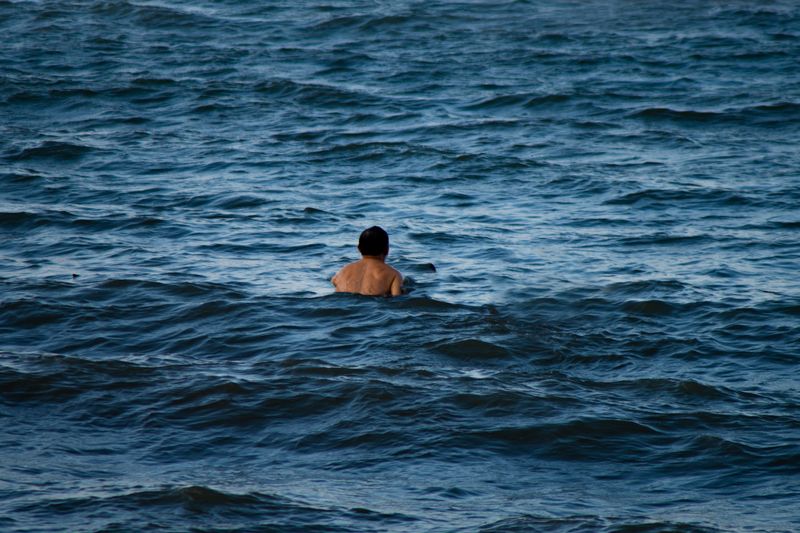
Often not in time. A low, dark head in choppy water is hard to spot even from a small boat, and large vessels have a substantial blind area ahead of the bow plus stopping distances measured in ship lengths.
Are harbour swimming bans universal?
No. They are set by individual harbour authorities and vary widely between ports and countries, with some harbours having designated areas and others prohibiting swimming entirely. The harbour office is the authority on its own water.