Coastlines
Tidal Range Is the Number That Changes Most Between Coasts
Some coasts move a few centimetres between high and low water and others move the height of a house, and almost everything follows from that.
Everything here earned its place by changing an outcome. Nothing about differences in tidal range between coasts is included to round the number up.
What matters most
- Range depends on ocean basin shape and resonance, not on how big the sea is.
- A large range drives strong tidal streams and exposes wide areas of shore.
- A small range does not mean a still sea, only that surge and wind matter relatively more.
Why the same moon produces different tides
The tide is a wave in an ocean basin, and how high it rises depends on the shape of the basin it is running in. Where a wide tidal wave is funnelled into a narrowing bay or channel, the same energy is squeezed into less width and rises higher. Where a sea is nearly enclosed and small, the tidal wave has little room to build and the range stays minimal.
There are also points in every ocean around which the tide rotates, and close to them the range is very small indeed. The moon is doing the same thing everywhere, so any difference you notice between two coasts comes from local geometry.
What a big range does to the shore
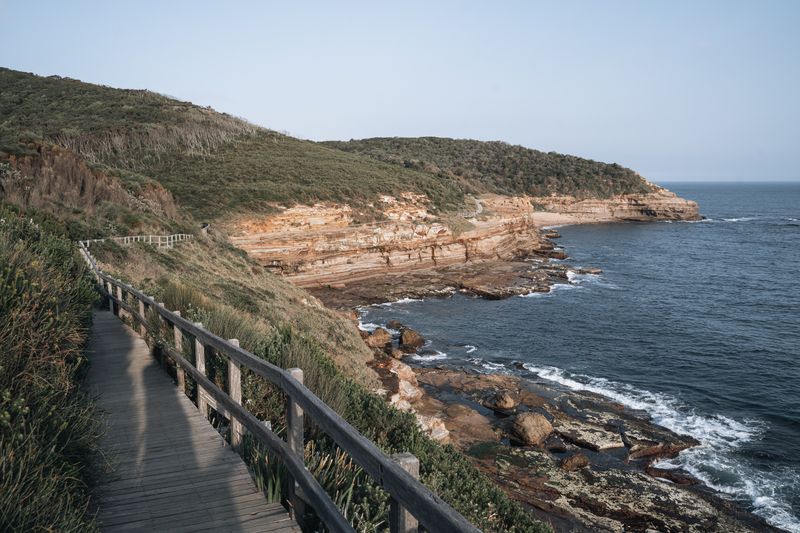
On a coast with a large range, low water can uncover hundreds of metres of sand, mud or rock that were sea a few hours earlier. That exposure produces the strandline life, the bait diggers, the rock pooling and the long walk to reach the water.
It also means the same beach photographed twice in a day looks like two entirely different landscapes. Ground that is uncovered twice daily supports nothing that cannot survive both immersion and drying, which is why it looks bare. Anything left on that ground, from a car to a folding chair, is on a surface that will be underwater again shortly.
Range and stream are linked
Moving all that water in and out takes flow, and the bigger the range the more water has to pass in the same six hours. That is why coasts with dramatic ranges also have strong tidal streams, particularly in narrows and around headlands. Tidal height and tidal stream are separate quantities, and the stream does not stop when the height reaches its maximum.
Along that stretch of coast, a rising tide over a wide flat area advances horizontally far faster than the vertical rise alone suggests. That advance is why people become cut off on sandbanks and causeways on coasts they think of as gentle.
Coasts where the tide is barely there
On some enclosed seas the daily range is small enough that harbours never dry and boats sit at fixed pontoons. Small range does not mean the water level is constant, because wind and atmospheric pressure can push it up or down noticeably. In some semi-enclosed basins the water sloshes at its own natural period, producing level changes unrelated to the moon.
Storm surge on such a coast arrives without a low tide to absorb it, which is one reason it can be so damaging. So a small-range coast is not simpler; the variability just comes from the weather rather than from the calendar.
Range changes through the month as well
Every coast has larger ranges around the times when the sun and moon line up and smaller ones a week later. The difference between those two weeks can be substantial, and it decides whether a low-water feature is exposed at all. Tidal causeways, sea caves, cut-off coves and low-water rock platforms are only reachable on the bigger ranges.
Before the first ferry, anyone planning around such a feature has to choose the week, not just the day, before booking anything. Local tide tables published for the nearest standard port are the source for that, with corrections for smaller places nearby.
Timetables on small routes shift with the season and with the weather on the day.
Finding the number for a specific place
Ranges are published per port, and neighbouring ports on the same coast can differ enough to matter for a plan. Predictions are astronomical, so actual water levels differ when the weather is unusual, sometimes by a large margin. Times and heights are not universal, and a table for one country is useless in another, even on the same sea.
Harbour offices, national hydrographic services and posted local information are the places that hold the correct version. Reading it before arriving turns a coast from a series of surprises into something with a legible timetable.
Everything above, in order of what to do first
- Why the same moon produces different tides. The tide is a wave in an ocean basin, and how high it rises depends on the shape of the basin it is running in.
- What a big range does to the shore. On a coast with a large range, low water can uncover hundreds of metres of sand, mud or rock that were sea a few hours earlier.
- Range and stream are linked. Moving all that water in and out takes flow, and the bigger the range the more water has to pass in the same six hours.
- Coasts where the tide is barely there. On some enclosed seas the daily range is small enough that harbours never dry and boats sit at fixed pontoons.
- Range changes through the month as well. Every coast has larger ranges around the times when the sun and moon line up and smaller ones a week later.
- Finding the number for a specific place. Ranges are published per port, and neighbouring ports on the same coast can differ enough to matter for a plan.
The takeaway
Look up the range before the forecast, because on some coasts it decides more of your day than the weather does.
Weather is the itinerary. Everything else is a preference.
Questions readers ask
Why do some coasts have one tide a day instead of two?
The balance of tidal components varies by ocean basin, and in some places the daily component dominates the twice-daily one. The result is a single high and low each day, or a mixed pattern with two very unequal highs.
Does a big tidal range mean dangerous water?
It means fast-moving water and ground that floods, which is a specific set of hazards rather than general danger. Conditions on any particular stretch of shore are a question for local harbour, lifeguard or coastguard information.