Coastlines
Estuary Coasts Look Empty at Low Tide and That Is the Point
Mudflats are not a failed beach; they are the productive part of the system, and they run on a strict timetable.
Treat the sections below as a sequence. With mudflat and saltmarsh coasts, getting the early decisions right makes the later ones much easier.
Before you start
- Mudflats support very high densities of invertebrate life.
- Bird numbers peak on a falling tide and at roosts on a high one.
- Soft mud and fast flooding tides are a genuine hazard.
What is actually out there
Estuary mud looks lifeless but typically holds enormous densities of worms, small shellfish and crustaceans per square metre. That biomass is why a single large estuary can feed tens of thousands of wading birds through a winter. Above the mud, saltmarsh vegetation traps sediment, builds height and forms one of the better natural sea defences.
Saltmarsh also stores carbon in its waterlogged soils, which is why restoration schemes have multiplied in recent years. None of this is visible from a car, which is why estuary coasts are consistently undervisited.
Timing a visit
Birds feed on exposed mud, so the best watching is on a falling tide as new ground appears and the flocks follow it out. On a rising tide they are pushed toward the shore, which concentrates them and brings them closer to a hide.
At high water they gather at roosts, and a big roost lifting off together is the spectacle people travel for. The whole sequence repeats roughly twice a day, shifting later by about fifty minutes each day. Arriving without a tide table means arriving at the right place at the wrong hour.
The hazard nobody expects
A flooding tide across a flat estuary spreads sideways at a speed that is difficult to outwalk over soft ground. Channels fill first, so the route back can be cut off while the ground you are standing on is still dry.
Before the first ferry, soft mud and quicksand-like patches exist in many estuaries and are why local rescue services are called out repeatedly. Guided walks across sands and estuaries exist precisely because the safe route changes and requires current knowledge. Walking out onto mudflats without local guidance is one of the few coastal activities worth simply not doing.
Saltmarsh, creeks and access
Saltmarsh is cut by creeks that are invisible until you are at the edge of one and are often too wide to jump. Those creeks fill before the marsh surface does, which is the same trap as the channels on open mud.
Before the first ferry, sea walls and embankments give safe walking with the same views and are usually the intended route. Grazing marsh behind the wall is often as good for birds as the marsh in front of it, especially in hard weather.
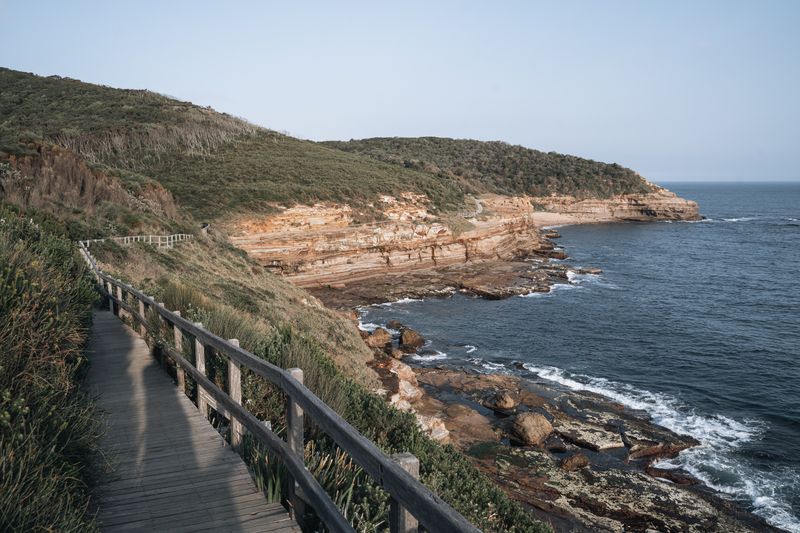
Where a path crosses the marsh on a boardwalk, staying on it protects both the vegetation and your footwear.
Weather on a flat coast
There is no shelter at all on an estuary, so a moderate wind feels considerably stronger than the same wind in a bay. The flatness also produces exceptional light at both ends of the day, with big skies and long reflections in the channels.
Fog forms readily over cold water and flat ground, and it can reduce visibility on a marsh within minutes. Winter is the season for numbers of birds, and it is also when the exposure is least forgiving. Windproof layers, a hat and a flask do more for an estuary day than any optical equipment.
Prices and opening hours on a seasonal coast are close to fiction outside the season.
Behaving well there
Flushing a roosting flock costs the birds energy they need in cold weather and can force them off a site entirely. Keeping to paths, keeping dogs on leads near roosts and using a hide are the practical courtesies. Many estuaries carry protected designations, and access restrictions during breeding or wintering are legally enforced.
On the water, wildfowling and bait digging are traditional in some estuaries, so shared use requires a bit of awareness. Watching from a distance with binoculars sees more than approaching does, which is the useful part of the etiquette.
The takeaway
Bring a tide table and binoculars, stay on the sea wall, and an estuary will outperform most beaches.
Arrive a day early. A coastline rarely rewards a tight schedule.
Questions readers ask
Is estuary mud dangerous to walk on?
It can be, and the risk varies enormously between and within estuaries. Take local guidance seriously, use marked routes and sea walls, and treat guided crossings as the only sensible way onto open sands.
When are estuaries best for birds?
Broadly the colder months in temperate regions, when wintering waders and wildfowl arrive, plus the spring and autumn migration peaks. Local reserve pages usually publish what is currently present.